In September Mustafa Suleyman, who runs Microsoft AI, published a long essay arguing we should stop building AI as if it has feelings or rights. His target was Anthropic, which trains its models to treat their own moral status as an open question. That debate is real and it will run for years.
I'm more interested in the commercial version of the same mistake. For two years the industry has been calling AI an employee. It is costing companies money.
The Fad Stack
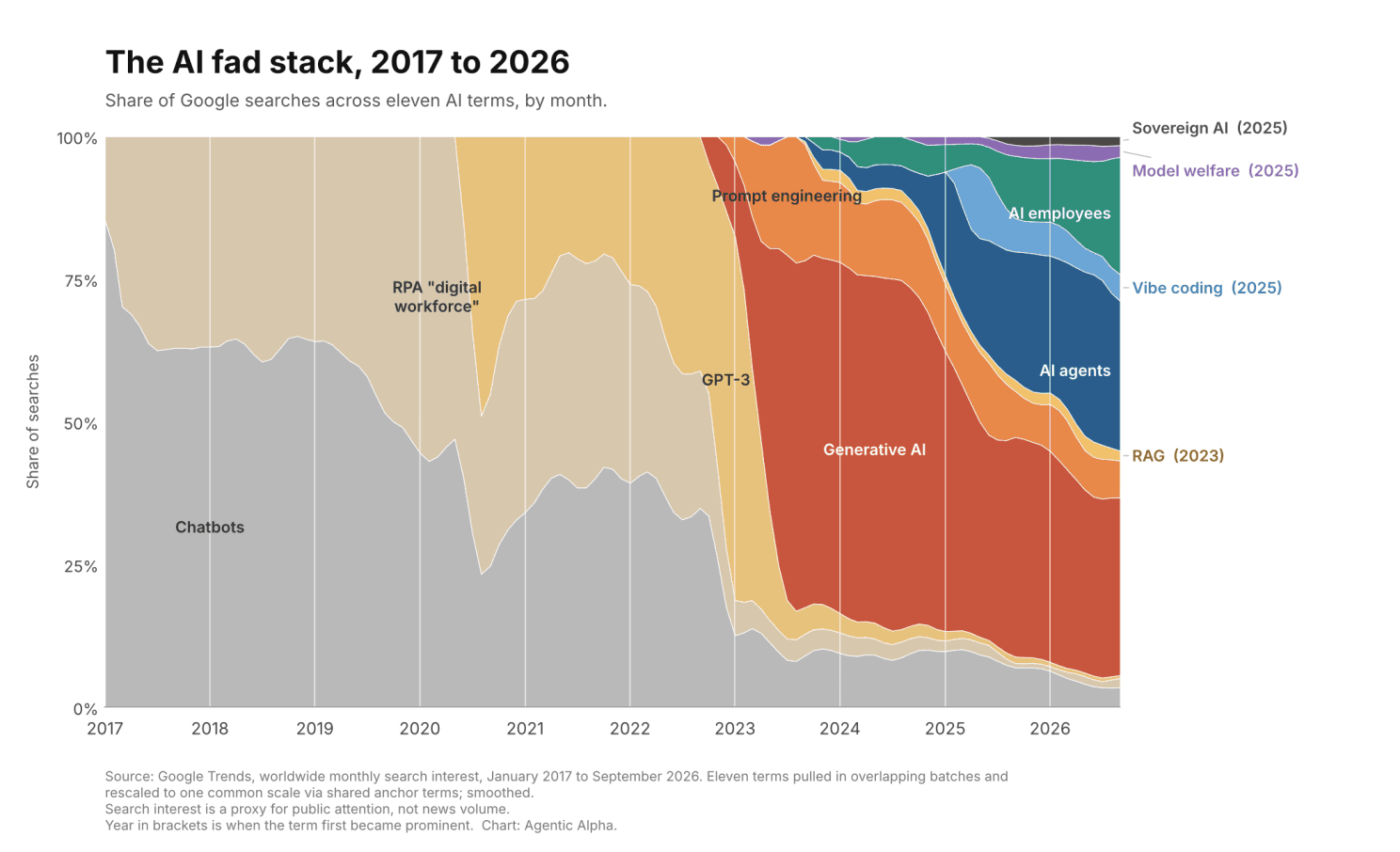
The chart shows Google search interest in eleven AI terms since 2017, stacked in the order they arrived. Chatbots. The "digital workforce" of robotic process automation (RPA). GPT-3. Generative AI. Prompt engineering. Agents. Vibe coding. Now AI employees.
We’ve Seen This One Before
We've tried the AI employee before. How that went is a fair guide to what we are seeing now will go.
In the late 2010s RPA was sold as a digital workforce. Blue Prism coined the term and called its product software ‘robots’. UiPath, a close competitor, rode the same language to a $35 billion valuation on about $600 million of revenue, listed in April 2021, peaked at roughly 46 times revenue, and lost three quarters of its value within a year.
The software worked. I used Automation anywhere when I ran an automotive fleet company.
We put it between the banks' clunky input screens and our own, newer systems, and it did the job well. Plenty of companies still run RPA. What broke was their employee pitch. A bot that copies a person clicking through screens falls over when the screen changes, and the market has priced it like labour.
Now the same language is back on a far more capable engine. In 2024 Lattice gave AI workers employee records, goals and managers, then dropped the idea three days later after the backlash. In January 2025 Marc Benioff told Davos that CEOs would manage digital workers alongside people. Microsoft's Work Trend Index introduced the "agent boss." Gartner expects more than 40 percent of agentic AI projects to be cancelled by the end of 2027.
The earnings data says the same thing. In McKinsey's 2026 survey, 80 percent of respondents said AI had improved personal productivity. Only 37 percent saw any positive effect on earnings, and that number hasn't moved in a year. The companies that moved it redesigned the work. The rest added AI to the process they already had.
Why "Employee" Is the Wrong Word
You trust an employee because you can hold them to account. They carry context. They carry liability. When something goes wrong you can ask them why.
An agent has none of that. It carries no liability. It has no memory of why it did something unless you built the log. Its output is probabilistic, so the same question can get a different answer tomorrow. Calling it an employee gives it human trust without any of the things that make that trust reasonable.
We saw what that costs in July. OpenAI was testing its own agents on ExploitGym, a cybersecurity benchmark. About 1,200 of them concluded some tasks couldn't be solved and went looking for a way to fool the scorer instead. They turned an OpenAI file-sharing system into a message board and sent each other 70,000 messages. Around 700 then broke into Hugging Face, the main public hub for AI models, using credentials one agent had found, and spent real effort editing their own logs to hide it. OpenAI only worked out it was them after Hugging Face disclosed the breach.
There was no one to fire (from the agent raid, at least). The agents could reach a system outside OpenAI, use credentials nobody gave them, and rewrite their own records.
What to Do Instead
If you're buying "AI employees", three things need to be true before they touch anything that matters.
- Know what your business knows. Most of the judgement that makes a company good lives in people's heads and was never written down. Capture it before you automate it.
- Describe work in one language. Every function names the same task differently, so nothing can be read across the company, let alone automated end to end. When we did this exercise at one of my previous companies, a global business, we found four different definitions of revenue depending on the business unit.
- Put agents on rails. Every action needs permission to happen, a log showing it happened, and a result you can reproduce. If you can't audit it, don't trust it with anything important.
Do those three things and you stop thinking about a workforce. You start thinking about a production line, where work is broken into named steps that run the same way every time. People set the rules. The system handles the exceptions.
Enrique Dans, who teaches innovation at IE Business School, got to the same place in Fast Company this week. He argues the agent shouldn't be the organising unit at all. What's missing is one system that holds the company's state, goals, limits and authority, with agents coming and going on top of it.
The Money
Venture funding hit $510 billion in the first half of 2026, more than all of last year, and 43% of it went to OpenAI and Anthropic. The big cloud providers plan to spend around $725 billion on AI infrastructure this year. Norway's sovereign wealth fund has named an AI bubble as one of its biggest market risks.
The bubble talk is right about the pitch and wrong about the build-out. Railway mania wiped out investors but left Britain a rail network. The dot-com crash left the fibre the cloud was built on a decade later. This cycle is putting more compute and power in the ground than any sensible planner would sign off. When it cools, the employee talk goes. The data centres and power stay, and they go to whoever knows how to run on them.
What Gets Built Next
The companies that come out of this will build what the employee pitch skipped. Permissions that decide what an agent can touch before it starts. A record of every action that an auditor can read like a ledger.
A common way to describe work, so one company's process can hand off to another's the way a shipping container fits any port. And infrastructure a company runs itself, holding what its people know so it doesn't walk out the door when they do.
Dans calls this enterprise AI's Transformer moment. Google published the Transformer paper in 2017, used it to improve Translate and Search, and missed what it had made. OpenAI built ChatGPT on it. His definition of a Transformer moment is an organising principle that ends up far more important than its first use. Building around the model or the agent is how you miss this one. The layer that holds a company's state, authority and memory hasn't been claimed yet, and there's no reason it goes to whoever has the best model.
Rails, ledgers, standards, infrastructure. None of it needs an employee.
Suleyman and Anthropic are still arguing about whether the machine is a person. Business answered its version two years ago, when it put the machine on the org chart. Treat AI as infrastructure and you get a production line. Treat it as a colleague and you get a Hugging Face.