Operating layer Coordinate
Coordinate · case studies
Work running on the rails, inside the platforms businesses already use.
Three deployments where one task type runs on the rails inside the business’s existing flow, each step assigned to code, AI or a named person: the weekly beverage order for a venue, the match between a role and a candidate, and the proposal that answers a merchandise inquiry. Each case names the goal the task serves, who does each step, and what the results do not show yet.

eBev unified the ordering. Decidr runs the decision.
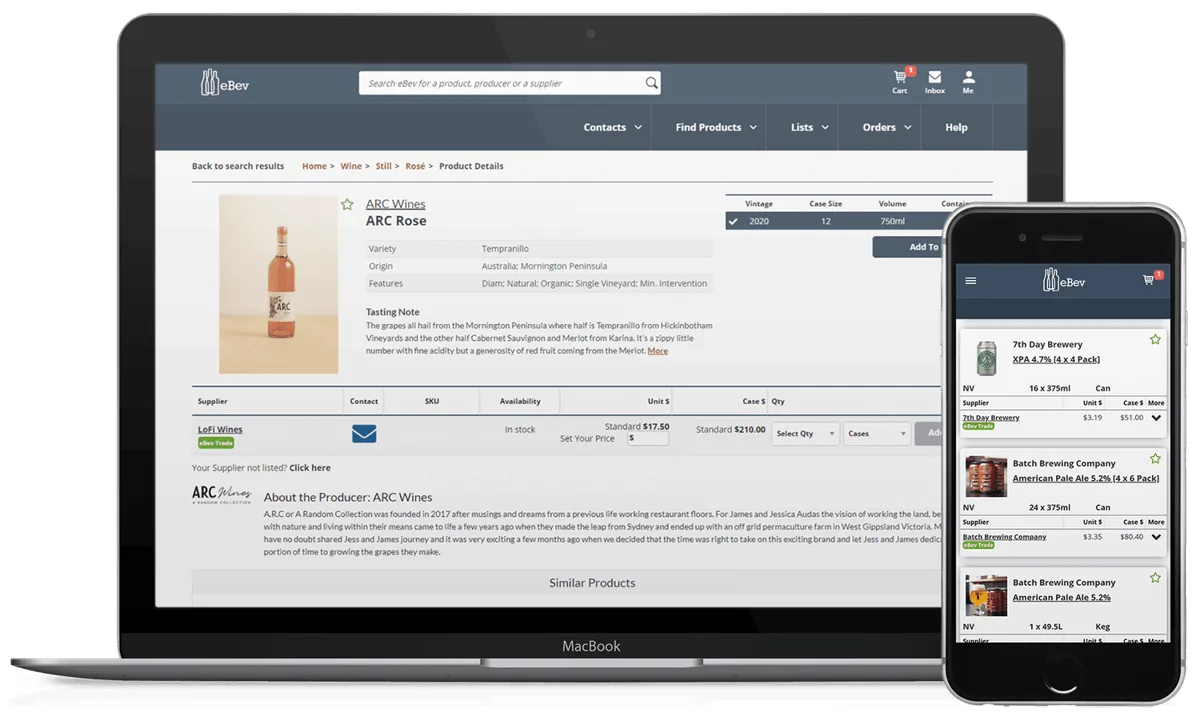
eBev is the procurement layer for Australian hospitality: around 5,000 pubs, bars, hotels and restaurants ordering from about 1,000 suppliers through one platform. Before it, a venue dealt with dozens of supplier portals, phone calls and PDFs. eBev solved that. The order itself was still worked out each week from memory and habit.
The goal it serves
Each venue’s weekly order, across every supplier, placed in minutes rather than hours, every week, with a person approving it.Range for stock-outs and over-ordering to confirm with eBev before publishing
What was done
Decidr runs inside eBev. Each cycle it reads consumption patterns, purchase history and stock position and produces a suggested order across every supplier. The venue team reviews it, adjusts for events and local knowledge, and places it. There is no new system to learn, and the suggestions improve with every order, adjustment and stocktake.
How it works in the venue
Results
Figures are from the live eBev deployment as at June 2026 and the May 2026 time study. The commercial terms of the partnership are not published.
What this does not show yet
Suggestions learn from history, so a new menu, a one-off event or a supplier change needs the venue team’s adjustment, which is why a person approves every order. The 90% acceptance rate is for the live cohort of 60 venues, not yet for the whole platform.

Matching roles to real skills, with people keeping the judgment.
CareerOne is one of Australia’s most recognisable job platforms, with high traffic and broad reach. Its model could not scale with precision: too many applicants and too few good fits, recruiters buried in administration, disjointed tools, and a poor experience for candidates and hiring managers.
The goal it serves
A short, qualified shortlist in front of the recruiter for every open role.Range and period to confirm with CareerOne before publishing
What was done
Decidr’s agentic hiring engine was integrated into CareerOne. Banjo matches roles to demonstrated skills rather than keywords. C1 AI surfaces pre-qualified candidates. Agents search, screen and sort, and the recruiter makes the call. The work is split into tasks with fixed inputs and outputs, so the autonomous steps run unattended and the judgment stays with a person.
The division of labor
Results
Figures as reported by CareerOne.
“The shift to instant, high-quality recommendations is transforming our model.”
Moussa Namini, COO, CareerOne
What this does not show yet
Matching on demonstrated skills works only where applicants evidence them; thin or unusual applications fall back to the recruiter. Engagement is not yet the same as a better hire, and placement quality is the result still to measure.
The same six tasks
Hiring in CareerOne’s words, mapped to the six standard tasks, each with its executor. The same shape as a venue order or a credit line.

Two to three hours per proposal, down to about ten seconds.
Mercha supplies branded merchandise to a long tail of customers across industries and positions itself as a technology business. Around 200 instant-quote requests arrive each month. Each proposal took two to three hours to put together, and three-quarters of inbound inquiries never converted.
The goal it serves
Every instant-quote request answered with an approved proposal inside the hour, across around 200 requests a month.Range to confirm with Mercha before publishing
What was done
Decidr’s forward-deployed team modeled Mercha’s domain into the graph: customers, contacts, products, artwork, quantities, pricing rules and the handoffs between them. On that schema they shipped a Proposal Generator, an agentic app that runs the full inquiry-to-proposal workflow, with an account manager approving before anything is sent. Every proposal and its outcome feeds back into the graph, so the next one is better informed.
How it runs
Results
Figures as reported by Mercha. Capacity is an estimate, not a measured volume.
“We’re a technology business. We want to scale revenue without just throwing bodies at it.”
Ben Read, CEO, Mercha
“You need to partner with somebody who’s building a solution for that future. That’s why we’ve partnered with Decidr.”
Ben Read, CEO, Mercha
What this does not show yet
Pricing rules cover the standard range; unusual artwork, quantities or rush orders go to the account manager. Ten seconds is the time to generate a proposal. Whether more inquiries now convert is the result still to measure.

Turn a quoting or proposal workflow into an app on the rails
All three start with capture, and each is one task type.
Each of these deployments ran on an operating model captured first, then mapped to a task type with a named executor for every step. The same task types, once named, can be offered on the Decidr Graph to vendors who specialize in them. Volumes are not yet published. The Capture case studies show how capture is done.