AI runs on probability. A business can’t.
A model guesses well. A business needs the same decision made the same way every time, because every goal is made of tasks. Decidr maps the work to one schema, assigns each task to the executor that does it best, and scores every run against its goal.
Every decision made again, from scratch. Click anywhere to bring order to it.
0 businesses on the Graph.
The layer that turns a goal into tasks and gives each one to rules, a model, a person or a vendor on the Graph.
Businesses that want every task done by whoever does it best, and the agents and vendors that need a way in.
Not a productivity tool but an economy for tasks, where every run is scored against its goal and a named person stays accountable.
Built with the organizations that use it.
Built alongside the customers who run on it and the partners who bring it to theirs.















Customers and partners, including AWS Partner and AWS Qualified Software status.
The Graph
Agents are arriving everywhere. None of them share a map of the work.
Consumer and enterprise agents now reach your business through their own connectors, app stores and browsers. None of them knows what your work is.
On the Decidr Graph your tasks are named, priced and callable by any agent, under rules you set. One integration, every agent, and one shared vocabulary that keeps the whole network coherent.
Claimed and agent-ready
Your business is already on the Graph. Claim it, connect the tools you use, and the operating model fills in.
Named and priced, with rules attached
Each task carries its inputs, outputs, price and rules. Build a task and you earn a share each time it runs.
Work moves between businesses
The vocabulary is shared, your operations stay private, and you can use, share or sell what you have built.
What is different
Decidr is the operating layer for the agentic era.
Agents, integration platforms, consultancies and automation each make a business a little faster at its own tasks. None names those tasks, scores them against a goal, or opens them to a market of specialists with a named person accountable.
Where this comparison is weakest. For one well-understood workflow, a bespoke build can be quicker to start. The difference shows from the second workflow on, when the schema, the rails and the captured reasoning carry over. Decidr is still gathering the evidence to put a number on it.
Capture first, then connect
Start with your people, in weeks, with nothing to integrate. Connect systems afterwards, to a map that already knows what it is looking at.
One schema, every industry
A venue, a bank and a hospital resolve to the same standard tasks. Adding your industry is set-up, not a rebuild.
A market for every task
Any repeatable task, however small, can go to a vendor who specializes in it, or to any agent that asks, under your rules, with the run scored. You decide who may do what.
The missing layer
Your systems record what happened. Nothing records why.
Your ERP knows what was approved. Your CRM knows what was sold. Neither knows which goal the approval served, why an exception is allowed, or which goal wins when two collide.
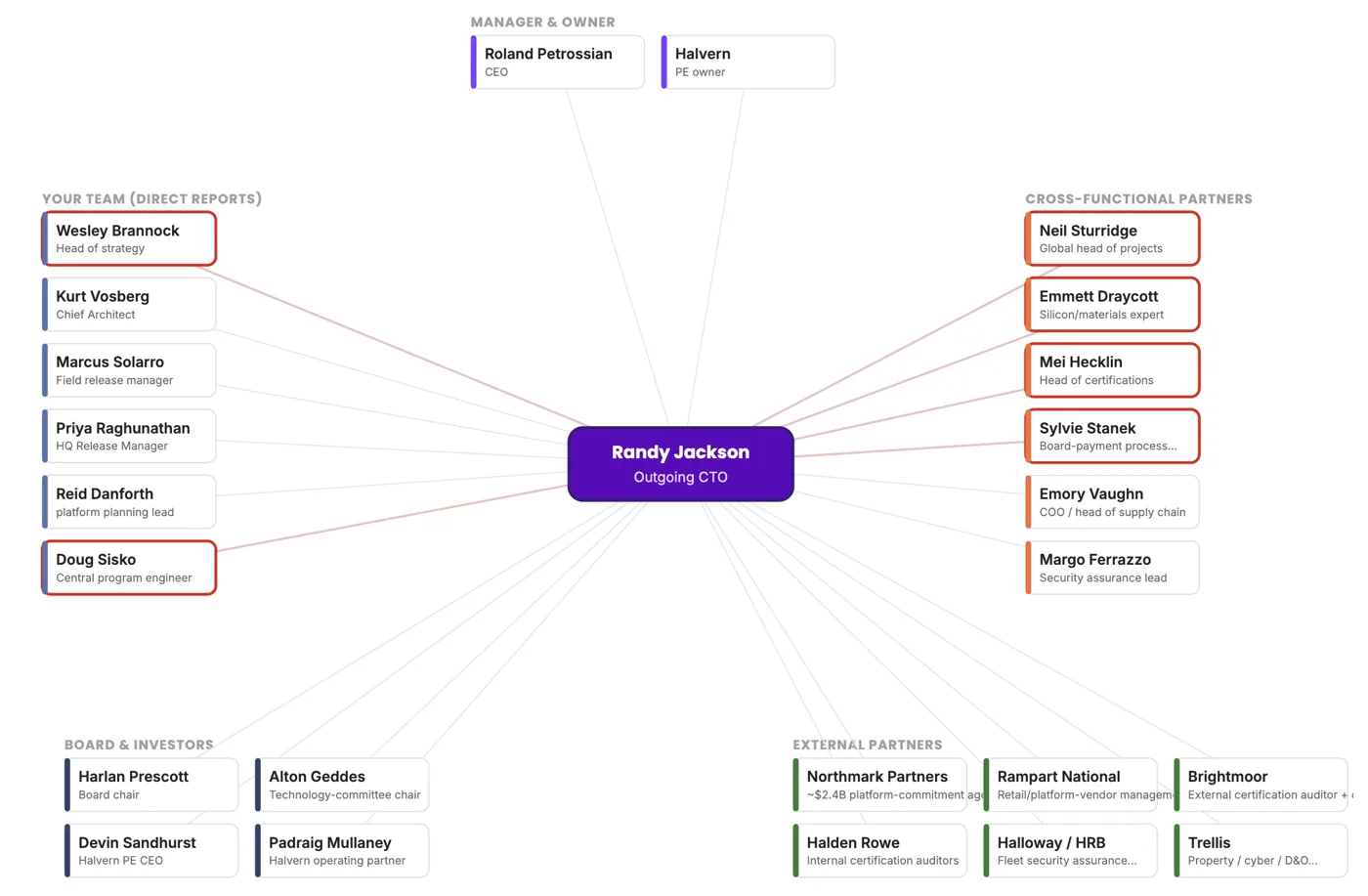
That knowledge sits with your people. Capture gets it out of their heads and into a graph you own, so whoever does a task, whether logic, code, AI, a person or a vendor, works from the same map.
- 80%of what an organization knows is held in its people’s heads, by the Delphi Group’s estimate.Cited in a USPTO filing
- 5.3 hrsa week lost per knowledge worker waiting for information or recreating it.Panopto Workplace Knowledge Report
- 95%of enterprise generative AI pilots show no measurable impact. MIT points to tools that never learn how the work is done.MIT NANDA, The GenAI Divide, 2025
People
Knowledge graph

The AP lead owns the Thursday payment run.
Capture
It starts with how the business already works.
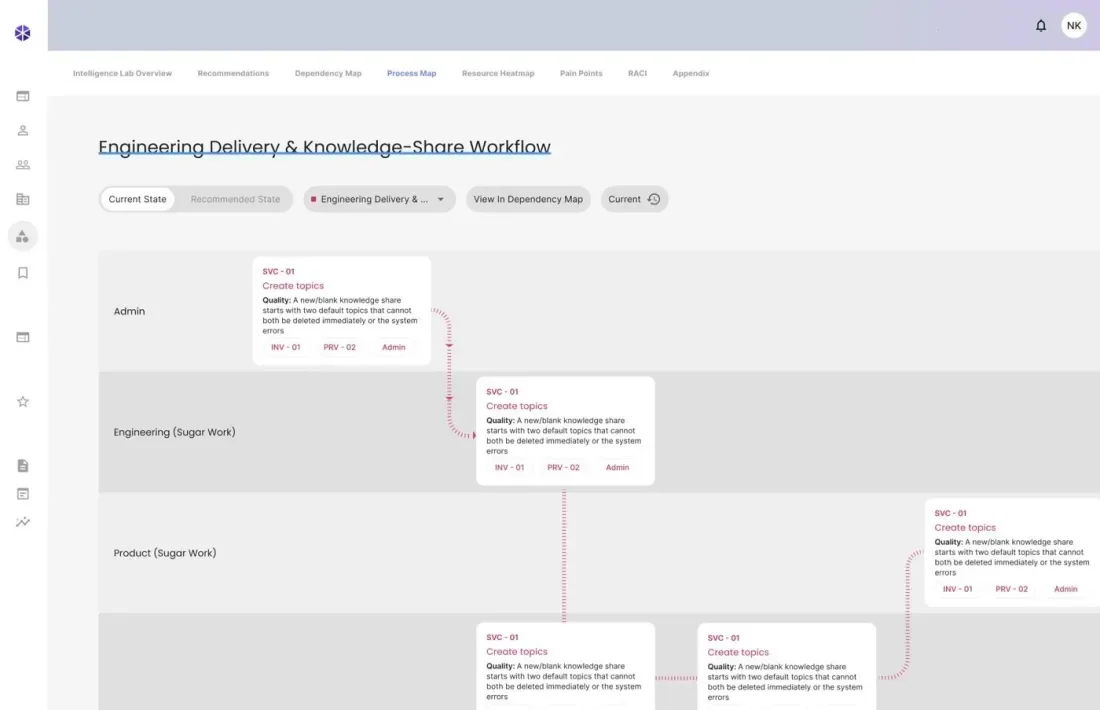
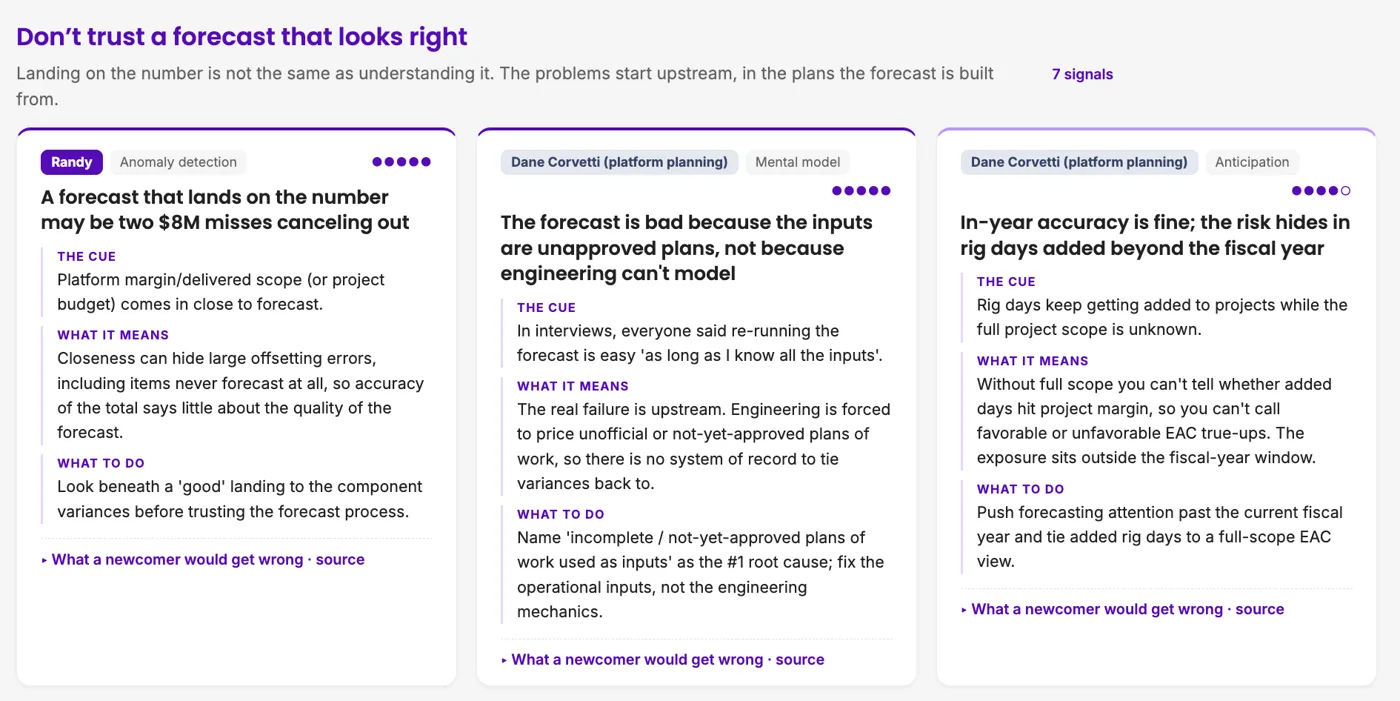
Capture is the first step. Decidr learns the business’s flows, its task types and its schema from the people who do the work, each point cited to the person who said it. A goal only runs once the business knows why the work is done, how it really flows, and which repeatable tasks it is made of.
What is the business steering toward?
Composed on decidr.ai. Everything below is captured relative to it.
Captured“Keep venue churn under three percent a quarter, even if it costs us margin.”
Why is the work done this way?
The exception rules and judgment calls behind each step. No system stores this.
Captured“We hold Friday orders for a second check. The Monday returns were killing us.”
How does the work really flow?
Handoffs, approvals and workarounds as they really run.
Captured“Anything over five thousand goes to Sam before the rep ever sees it.”
What is produced, by whom, and as which tasks?
Your entities, roles, systems and task types, each with a stable ID.
CapturedVenue · Order · Supplier · Rep · Approve a venue order, each with an ID the rails can call.
Your people lead the conversations. Decidr builds the make and model.
What comes out of the conversations is mapped to Decidr’s existing ontology. Where nothing matches, a custom schema is made.
Scope
Pick the function, process or role.
Converse
Guided, recorded conversations on Teams or Zoom.
Code
Every answer coded and cited to the moment it was said.
Map
Flows and task types mapped to Decidr’s ontology, or a custom schema made where nothing fits.
Schema · make and model
Every industry uses its own words. The tasks underneath are the same.
The flows that capture finds are mapped to Decidr’s ontology of task types. Where nothing matches, a custom schema is made. That mapping is the business’s make and model.
Pick your industry. Your words change. The six standard tasks underneath don’t, and a task type named once can be run, scored and traded anywhere.
Execution
Work runs down a production line.
A task type is a repeatable task assigned to one of four executors: conditional logic, code, AI or a person. Build the rails once, and every run is scored against the goal it served, then evaluated against that goal’s range at the end of each period. Here is an approval, as six tasks.
Decision log
Each step goes to the cheapest executor that can do it reliably. Your people take what needs authority, and the exceptions the rules can’t settle.
The agentic economy
A goal is a set of tasks completed into the future.
Everything on this page is done to achieve a goal, and a goal is nothing more than its tasks, completed, period after period. Name the tasks, score them against the goal, allocate each one to logic, code, AI, a person or a vendor, and the goal runs.
Decidr is not building a faster version of today’s business. It is building the economy that business operates in next: a graph where every task has a name, a score, and someone who does it best.
Same tasks, done faster
Today’s tools make a business quicker at the work it already does, by the people it already has.
Every task, scored and allocated
On Decidr each task is scored by the goal it serves and given to whoever does it best, inside the business or on the Graph.
Completed into the future
Each period the completed tasks are evaluated against the goal’s range, and the allocation is tuned for the next one.
Questions
Most frequent questions.
The questions that come up first.
Is this an agent, a platform or a data layer?
The layer under all three, with the Graph on top. It holds your operating model and schema, allocates each task to logic, code, AI, a person or a vendor, and scores the result against the goal. Agents, including Decidr’s own in BusinessOS, run on it. Start with capture
Why not connect our systems and let a model work it out?
Your systems hold what happened, not why. A model guessing the reasons guesses differently each time, and you end up supervising every run. Capture records them once. Capture first, then connect
How long does capture take?
About seven one-hour conversations per function, led by your own people, then the mapping to Decidr’s ontology. Ambient capture keeps it current after that. How capture works
Where does our data live?
With you. The operating model is yours, and sovereign capture and execution keep data and inference inside your boundary where you need them to.
What happens when a task falls outside the rules?
It goes to a named person, with the inputs and the reason. The rails never decide what you have reserved for a person. Watch a task run
Do other agents have to be built on Decidr to use it?
No. Your tasks are exposed in the schema, and any agent that calls them does so under your permissions. The Graph
Is this a productivity tool?
No. A productivity tool makes a business faster at its own tasks. Decidr names every task, scores it against the goal it serves, and allocates it to whoever does it best, including vendors on the Decidr Graph. That is an economy, not a speed-up. The agentic economy
Can other businesses do our tasks?
Yes. Any repeatable task type, however small, can be offered on the Decidr Graph to vendors who specialize in it. They do the work under your rules, and every job is scored against your goal. Volumes will be published once there is enough to measure. The agentic economy
Elsewhere on the site: BusinessOS, the product built on this operating layer · Why Decidr builds this way · Blog